Monday, July 8, 2013

HARGAILAH JANTUNG ANDA


  • Jantung manusia mula berdegup sejak dari dalam keadaan janin lagi.
  • Bayangkanlah berapa juta kali jantung anda telah berdegup sejak anda dilahirkan hinggalah sekarang tanpa berhenti walaupun untuk satu saat.
  • Bayangkanlah bagaimana kalau jantung anda perlu berehat sekejap daripada menjalankan 'tugasnya'?
  • Ini tidak mungkin berlaku kerana jantung merupakan salah satu daripada organ penting dalam sistem badan manusia dan ianya sangat unik kerana mampu untuk memulakan denyutan tanpa memerlukan sebarang ransangan daripada otak. Ianya dikenali sebagai pacemaker. Anggota atau organ badan yang lain memerlukan input atau arahan daripada otak sebagai pusat kawalan melalui sistem saraf untuk memulakan sesuatu tindakbalas atau kerja. 
  • Contohnya apabila kita terpegang sesuatu yang panas, otak akan menghantar isyarat kepada otot lengan untuk menarik tangan kita melalui sistem saraf dan deria.
  • Tetapi hal ini tidak akan berlaku pada jantung kerana ia akan sentiasa menjalankan fungsinya tanpa perlu sebarang ransangan dan input dari otak.
  • Oleh itu, jantung kita haruslah sentiasa dijaga dan dipelihara supaya tidak terlampau terbeban dan 'over work'. 
  • Antara perkara yang menyebabkan jantung kita terpaksa bekerja lebih kuat daripada biasa adalah apabila terdapat penyumbatan di dalam arteri (artherosclerosis) dimana aliran darah di dalam arteri terganggu  dan tidak dapat dialirkan dengan baik ke seluruh bahagian otot jantung dan organ-organ yang lain di dalam badan. 
  • Ini seterusnya akan menyebabkan berlakunya ischemia, suatu keadaan di mana organ-organ dan tisu di dalam badan mendapat bekalan darah yang tidak mencukupi yang disebabkan oleh penyumbatan yang berlaku di dalam arteri. 
  • Sekiranya keadaan ini berlaku pada jantung, ianya dikenali sebagai cardiac ischemia ataupun myocardial ischemia dimana bekalan darah dan oksigen ke otot jantung berkurangan, yang mana ia boleh merosakkan otot-otot jantung dan mengurangkan kebolehannya untuk mengepam darah ke seluruh badan. (dirujuk dari www.mayoclinic.com)
  • Penyumbatan separa atau sepenuhnya dalam arteri koronari akan menyebabkan bekalan darah ke otot jantung berkurangan ataupun terputus langsung, yang akan menyebabkan berlakunya serangan jantung (heart attack). 
BAGAIMANA MENCEGAH MASALAH INI?
  • Fenomena ini boleh dirawat dengan memberi tumpuan untuk memulihkan sistem aliran darah (vascular) agar ianya menjadi lancar dan bekalan darah dapat disampaikan ke seluruh organ badan pada kadar yang mencukupi terutamanya otot jantung.
  • Kaedah yang paling ringkas adalah pengambilan ubat-ubatan seperti 'Aspirin' yang boleh mencairkan darah dan mengelakkan berlakunya penyumbatan yang lebih teruk.
  • Selain itu, kaedah pembedahan seperti pemasangan 'balloon and stenting' atau Angioplasty dan juga  Coronary Artery By-Pass Graft (CABG) dapat menolong memulihkan keadaan ini.
  • Kaedah MODEN yang terkini ialah secara Non Invasive atau bebas pembedahan yang dikenali sebagai Enhanced External Counter Pulsation (EECP) mampu merawat masalah ini dengan berkesan dan selamat. Ianya merupakan kaedah rawatan tanpa pembedahan yang dapat merangsang pembukaan arteri kolateral (jaringan saluran darah) di sekeliling otot jantung dan juga kawasan arteri yang mengalami penyumbatan di dalam arteri tersebut. 
  • Pembukaan arteri kolateral ini secara terus menyelesaikan masalah penyumbatan yang berlaku di dalam saluran arteri utama, dimana darah dapat di alirkan melalui arteri kolateral yang baru ini ke seleruh bahagian otot jantung.
  • Apabila otot jantung mendapat bekalan darah dan oksigen yang mencukupi, ianya dapat berfungsi dengan baik seperti sediakala dan seterusnya membekalkan darah yang mencukupi ke organ-organ lain di dalam badan dengan mencukupi. 


Gambarajah diagnostik yang menunjukkan keadaan jantung sebelum dan selepas rawatan EECP dilakukan. Perhatikan jaringan saluran darah yang banyak (berwarna putih) telah terbentuk di sekeliling otot jantung setelah rawatan EECP dilakukan.

BAGAIMANA RAWATAN EECP INI DILAKUKAN?

Rawatan EECP ini perlu dilakukan sebanyak 35 sesi (1 jam per sesi) yang dilakukan pada kadar minima 5 sesi seminggu atau maksima 10 sesi seminggu. Ketika rawatan, pesakit hanya perlu baring di atas katil EECP dan rawatan dilakukan dengan mengepam di bahagian betis, paha dan pinggul oleh mesin EECP mengikut rentak jantung yang dibaca oleh sistem EKG (ECG) yang dipasang pada pesakit. 
Ianya 100% tanpa pembedahan dan ubat-ubatan dan terbukti sangat berkesan dan selamat.
Pesakit akan terasa seolah-olah diurut di bahagian betis dan paha dan tidak akan mengalami sebarang kesakitan sepanjang tempoh rawatan.

EECP BAIK UNTUK:

Secara dasarnya, rawatan EECP ini mampu untuk memulihkan masalah penyumbatan yang berlaku pada sistem aliran darah (Vascular System) di dalam badan manusia. Oleh itu, pelbagai masalah dan penyakit mampu diubati apabila sistem vaskular ini dapat dibaikpulih dan berjalan dengan lancar seperti:

i) Coronary Artery Disease (CAD) yang menyumbang kepada serangan dan juga kegagalan jantung
ii) Angina (Sakit dada / ketidakselesaan pada dada)
iii) Strok (penyumbatan saluran darah di bahagian otak tanpa pendarahan)
iv) Nephropathy dan Retinopathy pada pesakit diabetis
v) Erectile Dysfunction (ED) bagi lelaki yang disebabkan masalah aliran darah tidak lancar

dan pelbagai lagi......

SIAPA YANG PERLU MENJALANI RAWATAN EECP?

EECP adalah rawatan untuk semua golongan kerana ia bertindak melalui 3 senario yang utama iaitu:

i) Perawatan (Treatment)
ii) Pemulihan (Recovering / Rehabilitation)
iii) Pencegahan (Prevention)

Bagi tujuan perawatan, ianya sangat sesuai untuk pesakit yang mengalami penyumbatan serius di arteri koronari utama (80%, 90% atau 100%). Selain itu, ia juga sesuai bagi pesakit yang tidak mampu dan berisiko tinggi untuk menjalani rawatan pembedahan.

Untuk tujuan pemulihan, EECP boleh dilakukan pada mereka yang telah menjalani kaedah rawatan Angioplasty dan by-pass operation. EECP boleh dilakukan sebaik sahaja prosedur Angioplasty selesai dilakukan tetapi bagi pesakit yang baru menjalani pembedahan by-pass, EECP boleh dilakukan setelah pesakit sembuh sepenuhnya daripada kesan pembedahan tersebut.

Bagi mereka yang belum mempunyai sebarang simptom sakit jantung, rawatan EECP dapat dilakukan sebagai kaedah pencegahan daripada serangan jantung.

DIMANA EECP BOLEH DIDAPATI ?

Kaedah rawatan EECP ini boleh didapati di Farrali Health Naturale yang terdapat di Kuala Lumpur dan juga Pulau Pinang.

Alamat di Kuala Lumpur:
Farrali Health Naturale
65, Jalan Wangsa Delima 5
Wangsa Maju KLSC
53300, Kuala Lumpur
Tel: +603- 4148 1786  Faks: +603- 4144 4355


Alamat di Pulau Pinang.
Farrali Health Naturale
2486, 1st Floor,
Jalan Sultan Azlan Shah, 
11700, Gelugor, Pulau Pinang 
Tel / Faks: +604- 656 4171


Hubungi kami sekarang untuk mendapatkan sesi percubaan EECP anda dan juga khidmat rundingan kesihatan secara PERCUMA. 

Jangan berlengah lagi.

Tel: 019- 6681786 (En. Yazry Helmy) -KL
       019- 4490786 (En. Mohamad Khairi) - Penang
       012-2268786 (Dr. Mohd Ghouse)


Friday, June 21, 2013

BERTINDAK SEBELUM TERLAMBAT

Serangan jantung (heart attack) merupakan penyumbang utama kepada kadar kematian di negara ini. Penyakit ini berada pada tahap yang semakin membimbangkan dimana saban hari semakin ramai orang yang meninggal dunia disebabkan oleh masalah jantung. Risiko serangan jantung ini boleh berlaku pada sesiapa saja. Ada yang agak bernasib baik kerana mendapat simptom-simptom yang menjurus ke arah masalah sakit jantung dengan lebih awal sebelum ianya menjadi lebih serius, manakala tak kurang juga ada yang terus mengalami serangan jantung yang membawa kepada maut tanpa sebarang simptom atau mengalami masalah jantung sebelum ini.
Antara simptom-simptom yang biasanya di alami oleh mereka yang mempunyai masalah jantung ialah:

i) Kerap mengalami rasa sakit dan pedih dada (Angina) seperti rasa pedih ulu hati yang mencengkam dan menekan, rasa sakit di bahagian bahu, leher, dan belikat sebelah kiri,
ii) Tidak mampu berjalan jauh, kerana cepat berasa penat.
iii) Tercungap-cungap dan penat apabila menaiki tangga
iv) Berpeluh-peluh dengan tiba-tiba walaupun berada dalam bilik yang sejuk (aircond)
v) Berasa sesak nafas / sukar bernafas (gasping for air/shortness of breath)
vi) Cepat letih, lesu dan tidak bermaya.
vii) Kadar denyutan jantung yang tidak sekata (palpitation)

Kaedah rawatan yang biasa digunapakai sekarang ini ialah secara invasif iaitu melalui pembedahan. Terdapat dua kaedah rawatan invasif iaitu
i) Angioplasty / Stenting/ ballooning
ii) Pembedahan pintasan jantung (By-Pass Surgery)

Kini, terdapat kaedah rawatan sakit jantung secara bebas pembedahan (non invasif) , dikenali sebagai Enhanced External Counter Pulsation (EECP). Ianya 100% selamat dan berkesan, tanpa kesakitan dan tanpa pembedahan. Terbukti berkesan dan diiktiraf oleh US FDA.

Bertindaklah sekarang sebelum terlambat. Hubungi kami segera di talian 03- 4148 1786 atau     019-6681786 untuk mendapatkan sesi percubaan EECP anda sekarang.

Jangan berlengah lagi dan menyesal di kemudian hari. Semoga apa yang berlaku kepada saudari di dalam petikan di bawah ini tidak berlaku kepada kita semua.


Hubungi kami sekarang. EECP boleh didapati di Kuala Lumpur dan Pulau Pinang.


Tel 03-41481786


Monday, April 22, 2013

SPECIAL DISCOUNT FOR EECP ENROLMENT IN APRIL !!!

We would like to announce that we are giving out special promotion price for the EECP treatment for this month.
The actual price for EECP treatment is RM 12,000++ and now we are giving out discount for more than 30%.
Call us now or come and visit us to grab yourself this golden opportunity.
All you need to do is just pay your treatment cost at the discounted rate and we will schedule your treatment plan according to your availability.
Hurry up, this is a limited offer. 

CALL US NOW AT 03-4148 1786 OR 
019-668 1786
OR VISIT US 

Farrali Health Naturale
65, Jalan Wangsa Delima 5
Wangsa Maju KLSC
53300, Kuala Lumpur.


Wednesday, April 10, 2013


CONVENTIONAL THERAPY PROCEDURES FOR HEART PROBLEM
Currently, there are few ways of common therapeutic procedures to treat the heart problem.
a)Angioplasty and stenting (PCI)
b)By-Pass Graft (CABG)
c)Rotational Coronary Atherectomy (Rotoblade)

a)ANGIOPLASTY AND STENTING (PCI)
  • Also known as Percutaneous Coronary Intervention (PCI)
  • PCI is accomplished with a small balloon catheter inserted into an artery in the groin or arm, and advanced to the narrowing in the coronary artery.
  • The balloon is then inflated to enlarge the narrowing in the artery.
  • Typically, a small metal coil called a stent is implanted in the clogged artery to help prop the artery open and reduce the risk of it narrowing again.
  • When successful, PCI can relieve chest pain of angina,  improve the prognosis of individuals with unstable angina, and minimize or stop a heart attack without having the patient undergo open heart coronary artery bypass graft  (CABG) surgery.

b)CORONARY BY-PASS SURGERY (CABG) 


  • Also known as Coronary Artery Bypass Graft (CABG).
  • During CABG surgery, a section of healthy blood vessel(either artery or vein) — often taken from inside the chest wall or the lower leg — is attached above and below the blocked  coronary artery.
  • This creates a new passage, and oxygen-rich blood is routed around the blockage to the heart muscle.
  • CABG may need to be repeated if the grafted arteries or veins become blocked, or if new blockages develop in arteries that weren't blocked before.
  • Taking medicines as prescribed and making lifestyle changes as doctor recommends can lower the chance of  a graft becoming blocked.
c)ROTATIONAL CORONARY ATHERECTOMY 

  • Coronary Atherectomy is an invasive procedure to remove the blockage from the coronary arteries and allow more blood to flow to the heart muscle and ease the pain caused by blockages.
  • Rotational atherectomy uses a high speed rotating shaver to  grind up plaque. It can be used instead of, or along with, balloon angioplasty
  • If a treatable blockage is noted, the first catheter is exchanged for a guiding catheter. Once the guiding catheter is in place, a guide wire is advanced across the blockage, then a catheter designed for lesion cutting is advanced across the blockage site.  A low-pressure balloon, which is attached to the catheter adjacent to the cutter, is inflated to expose the lesion matter to the cutter.
  • The cutter breaks the blockage up into microscopic pieces. These tiny pieces are stored in a section of the catheter called a nosecone, and removed after the intervention is complete. Together with rotation of the catheter, the balloon can be deflated and re-inflated to cut the blockage in any direction, allowing for uniform debulking (What is debulking)
OUR SOLUTION FOR YOUR HEART PROBLEM
  • Non Invasive and Outpatient treatment
  • Very low risk
  • Higher success rate
  • Much lower treatment cost as compared to Angioplasty or Coronary Bypass Surgery
  • Eliminate other medical cost such as ward stay, nursing care etc.
  • Very effective to relief Angina and Coronary Artery Disease problem.
  • Known as Enhanced External Counter Pulsation (EECP)
  • Recognised by FDA
WHAT IS EECP? (video on EECP-click here)

  • EECP or Enhanced External Counter Pulsation is a mechanical procedure in which long inflatable cuffs (like blood pressure cuffs) are wrapped around both of patient's legs. 
  • While patient lies on the bed, the leg cuffs are inflated and deflated with each heart beat.
  • This is accomplished by means of a computer, which triggers off the patient's ECG so that the cuff deflate just as each heartbeat begins, and inflate just as each heartbeat ends.
  • When the cuffs inflate, they do so in a sequential fashion, so that the blood in the legs is "milked" upwards towards the heart. 
  • Each treatment will last for 1 hour.   

Kindly Refer to our previous entry for more information on EECP (click here)

COMPARISON BETWEEN EECP AND OTHER INVASIVE PROCEDURES

WHERE CAN I GET THE TREATMENT?
Come and visit us at Farrali Health Naturale
We are at Wangsa Maju, Kuala Lumpur.

Call us now to schedule your FREE EECP Trial session.

Call 019-6681786 or 012-2268786 

Farrali Health Naturale 
65, Jalan Wangsa Delima 5
Wangsa Maju KLSC
53300, Kuala Lumpur
Tel: 03- 4148 1786
Fax: 03- 4144 4355
Email: info@farrali.com.my

OPERATION HOURS:
MON-FRI: 8am to 6pm
SAT            : 9am to 1pm
SUN &PH: By appointment only

Tuesday, April 9, 2013

WHAT IS A HEALTHY HEART?


The heart, which is about the fist size, pumps more than 100,000 times a day of about 2,000 gallons of blood throughout the body.

Made up of 4 major chambers, namely right atrium, right ventricle, left atrium, left ventricle.
It has 4 valves to ensure the blood in the heart flows in the same direction and prevents the blood from flowing backwards.
The heart structure


THE WORKING PRINCIPLE OF HEART
  • The right side of the heart receives less oxygen blood  (deoxygenated blood) from cells and organs all over the body.
  • The deoxygenated blood will be pump to the lung to be re-oxygenated through Pulmonary Artery.
  • The left side of the heart receives rich oxygen blood (oxygenated blood) from the lung.
  • It will pump the oxygenated blood to the whole of body through Aorta
  • When blood travels around the body, it will supply Oxygen and nutrients to tissue through capillaries.
  • At the same time, blood will also picks up Carbon Dioxide and waste material away from tissue.
  • The vein returns the deoxygenated blood to the right atrium of the heart  and the cycle begins again.

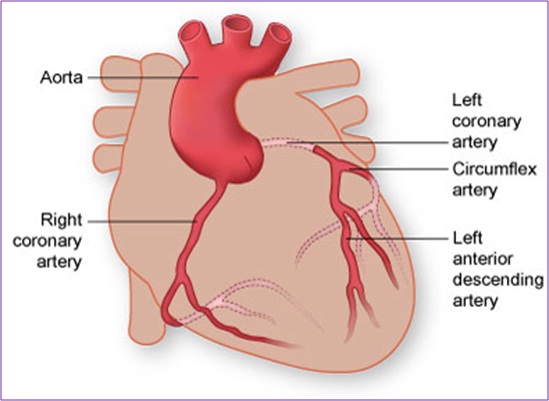
CORONARY ARTERIES 
  • As blood circulates through the Aorta, some of the blood flows through much smaller blood vessel  that surrounds the heart, called Coronary Artery which supplies Oxygenated Blood to the heart.
  • This separated circulatory System is called Coronary Circulation which keeps the heart nourishes and oxygenated
  • The two main branches of the artery is called Right Main Coronary Artery and Left Main Coronary Artery.

HEALTH PROBLEM ASSOCIATED WITH HEART

 ANGINA
  • severe chest pain  due to ischemia (a lack of blood, hence a lack of oxygen supply) of the heart muscle, generally due to obstruction or spasm of the coronary arteries (the heart's blood vessels).
  • Chest pain or discomfort above the diaphragm that occurs when the heart muscle does not get enough oxygen-rich blood.
  • Angina may feel like pressure or squeezing in the chest. The pain can radiates to the left or right arm and shoulders, neck, jaw and back . It can also feel like indigestion.
  • It is not a disease but a symptom of heart problem, usually associated with Coronary Artery Disease.
  • There are 3 types of Angina, which are listed below:


a)Stable Angina
Most common type. It occurs when heart works harder than usual and has regular pattern. The pain usually goes after a few minutes after resting or taking medicine.
b)Unstable Angina
Doesn’t follow a pattern. It occurs with or without physical exertion and may not be relieved by resting or taking medicine. It is very dangerous and requires emergency treatment.  It is a sign that heart attack may happen soon.
c)Variant Angina

Coronary Artery Disease (CAD)
  • a condition in which plaque builds up inside the coronary arteries. These arteries supply your heart muscle with oxygen-rich blood.
  • It occurs when patient is at rest and the pain can be severe, usually between midnight and early morning. Medicine can relief this type of Angina.
  • .These arteries supply the heart muscle with oxygen-rich blood.
  • Plaque is made up of fat, calcium, protein and other substances found in the blood. When plaque builds up in the arteries, the condition is called atherosclerosis .
  • Plaque narrows the arteries and reduces blood flow to the heart muscle. It also makes it more likely that blood clots will form in the arteries. Blood clots can partially or completely block blood flow.
  • The lack of blood flow which supplies oxygen to the heart causes the heart muscle to damage and leads to heart attack.
Congestive Heart Failure (CHF)
  A condition where heart’s function as a pump is inadequate to deliver oxygen rich blood to the tissue in the body. It may be caused by:
a)Diseases that weaken the heart muscle.
b)Diseases that cause stiffening the heart muscle such as viral infections and iron overload.
c)Diseases that increase the Oxygen demand by the body tissue beyond the capability of the heart  such as Anemia and Hyperthyroidism 
CHF affects many organ’s function ability such as:
a)When kidney get less oxygen supply, it will loose its ability  to excrete salt and water. This causes more fluid to retain in the body. The congestion of the fluid in body will also put more strain to the already weak heart and cause it to swell.
b)The lungs may become congested with fluid and decrease the ability of a person to exercise.
c)Excessive fluid may retain in liver thereby impairing the ability to get rid off the toxin and produce essential proteins.
d)The intestines become less efficient to absorb nutrients and medicine.
e)Fluid may also accumulate in extremities, resulting in swelling of the
  ankles and feet (edema).

Cardiac Arrest


  • Cardiac arrest is the sudden loss of cardiac function, when the heart abruptly stops beating.
  • It stops normal breathing, and the pulse and blood pressure will be absent. Unless resuscitative efforts are begun immediately, cardiac arrest leads to death within a few minutes. This is often referred to as "sudden death" or "sudden cardiac death (SCD)."
  • Ventricular fibrillation is the most common cause of cardiac
  • arrest. It occurs when the normal, regular, electrical activation of heart muscle contraction is replaced by chaotic electrical activity that causes the heart to stop beating and pumping blood to the brain and other parts of the body.
  • Permanent brain damage and death can occur unless the flow of blood to the brain is restored within five minutes.

Heart Attack (Myocardial Infarction)

  • Occurs when one of the coronary arteries that supply blood to the heart are blocked, preventing enough oxygen from getting to the heart. The heart muscle dies or becomes permanently damaged. 
  • If the blood flow is blocked, the heart starves for oxygen and heart cells die.
  • A heart attack can occur as a result of the following:
  • 1.The slow build up of plaque may almost block one of the coronary arteries. A heart attack may occur if not enough oxygen-containing blood can flow through this blockage. This is more likely to happen during exercising.
  • 2.The plaque itself develops cracks (fissures) or tears. Blood platelets stick to these tears and form a blood clot (thrombus). A heart attack can occur if this blood clot completely blocks the passage of oxygen-rich blood to the heart. This is the most common cause.


Friday, April 5, 2013

EECP SAVES LIFE

Knowing what EECP is all about?


  • EECP or Enhanced External Counter Pulsation is a mechanical procedure in which long inflatable cuffs (like blood pressure cuffs) are wrapped around both of patient's legs. 
  • While patient lies on the bed, the leg cuffs are inflated and deflated with each heart beat.
  • This is accomplished by means of a computer, which triggers off the patient's ECG so that the cuff deflate just as each heartbeat begins, and inflate just as each heartbeat ends.
  • When the cuffs inflate, they do so in a sequential fashion, so that the blood in the legs is "milked" upwards towards the heart. 
  • Each treatment will last for 1 hour.   
The inflation and deflation sequences

HOW IT WORKS?(See video of EECP)

  • This non-invasive technique provides augmentation of diastolic blood flow and coronary blood flow to the heart similar to the intra-aortic balloon pump (Angioplasty), utilizing the serial inflation of three sets of cuffs which wrap around the calves, thighs and buttocks.
  • While the heart is at rest, the treatment cuffs inflate from the calves to the thighs to the buttocks, which increases the blood supply to the arteries feeding the heart muscle.
  • Just before the next heart beat, all the cuffs deflate at the same time, which decreases the amount of work the heart has to do.
  • Inflation and deflation is timed to the patient's ECG and the arterial pressure waveform is monitored noninvasive.
  • The overall hemodynamic effect is to provide diastolic augmentation and thus increase coronary perfusion pressure; to unload systolic cardiac workload and therefore decrease myocardial oxygen demand; and to increase venous return and subsequently, cardiac output.
  • The treatment need to be done 1 hour a day, for five days a week which last for seven weeks, amounting to 35 sessions.
BENEFITS OF EECP

Low-Risk Treatment for  Angina                                                                                
A low-risk treatment for angina and heart problem, EECP  gently but firmly compresses the vasculature of the legs to increase blood flow to the heart, ultimately reducing or eliminating chest pain (Angina) What is Angina? Click here

No Recovery Time or Pain
EECP can relieve angina and heart problem without surgery and hospitalization or the associated pain and recovery time.

A Natural Bypass
EECP increases blood flow to the heart, by opening and expanding networks of small blood vessels within the Coronary Arteries called collaterals. These channels can create "natural bypasses" around clogged arteries, boosting blood supply to oxygen-deprived areas of the heart.
Ultrasound showing the collateral arteries being formed surrounding heart muscles after 35 sessions of EECP treatment


Active Again
EECP can reduce or eliminate the frequency and intensity of chest pain and remove the need for angina medication. After treatment, patients are usually able to enjoy everyday activities, which frequently include moderate exercise, walking, gardening and travelling.

Generally, EECP is used to treat :
  • Chronic stable angina (lack of blood to the heart that causes severe chest pains)
  • Coronary artery disease, CAD. What is CAD? Click here
  • High blood pressure
  • Congestive heart failure What is congestive heart failure? Click here
  • Heart attack (MI) What is MI? Click here
The advantages of EECP are:
  • Non-invasive
  • Does not require a hospital stay  thus eliminating other medical cost.
  • No recovery period
  • Allows patients to return to their routine each day after receiving treatment.
  • Very low risk.
  • Higher success rate.
  • Last longer before recurrence of other Angina.
  • No need to go for any invasive procedure (stenting & by-pass) anymore
WHO SHOULD CONSIDER FOR EECP?
This procedure is particularly effective for those who:

  • Have had Coronary Angioplasty /Stents or Coronary Artery Bypass graft surgery, but their heart disease symptoms have returned
  • Are not candidates for surgery because of other medical conditions (not fit)
  • Do not want to undergo surgery
  • Have diabetes
  • Have small vessels (often women)
  • Rely on medications
  • Normal healthy people, as preventive  treatment.  
COMPARISON BETWEEN EECP AND OTHER INVASIVE PROCEDURES
CONCLUSION


WHERE CAN I GET THE TREATMENT?
Come and visit us at Farrali Health Naturale
We are at Taman Setiawangsa, Kuala Lumpur.

Call us now to schedule your FREE EECP Trial session.

Call 019-6681786 or 012-2268786 

Farrali Health Naturale 
65, Jalan Wangsa Delima 5
Wangsa Maju KLSC,
53300, Kuala Lumpur
Tel: 03- 4148 1786
Fax: 03- 4144 4355
Email: info@farrali.com.my

OPERATION HOURS:
MON-FRI: 8am to 6pm
SAT            : 9am to 1pm
SUN &PH: By appointment only